|
|||||||||
| PATHWAYS POINTERS OVERVIEW | |||||||||
 |
|||||||||
Don't Just Receive Feedback—Put It to Work! |
|||||||||
|
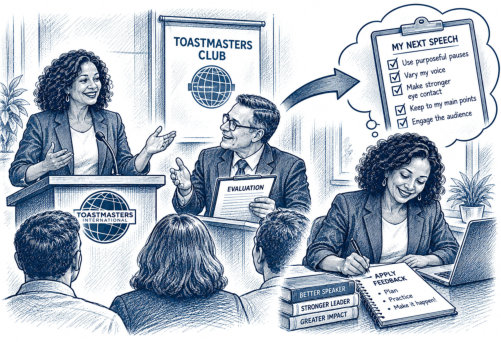
You have just finished a speech. Your evaluator offers thoughtful observations, highlights what you did well, and suggests ways to improve. You listen, thank the evaluator, and sit down. But what happens to that feedback after the meeting? Feedback is only the beginning. Real growth happens when you put it into practice. Every evaluation can become a practical plan for your next speech, your next meeting role, or a presentation outside Toastmasters. Why It's Important Pathways encourages members to learn through preparation, experience, reflection, and feedback. An evaluation helps you see your performance from another person's perspective. It may reveal a strength you did not recognize or an opportunity you overlooked. But simply receiving suggestions does not automatically improve your speaking. Improvement comes from selecting a useful recommendation, practicing it deliberately, and checking whether it made a difference. Turn Feedback into Action: Five Simple Steps
Helpful Tip After every speech, write down one thing to keep doing, one thing to improve, and one action to take before your next presentation. Keep these notes with your Pathways project materials so you can track your growth over time. Don't just collect feedback. Turn it into progress! A Simple Example Suppose your evaluator says, “Your story was engaging, but some of your most important points went by too quickly.” Rather than simply promising to slow down, turn that observation into a measurable practice goal:
One specific change can make a speech more effective. Over several projects, those small improvements become lasting habits. Feedback Is Useful Beyond Prepared Speeches The same approach works when you serve as Toastmaster of the Meeting, lead Table Topics, facilitate a club discussion, or take on a leadership assignment. You can also apply it to workplace presentations, interviews, community meetings, and everyday conversations. A Role for Mentors and Club Officers Mentors and Vice Presidents Education can help members connect one project to the next. Ask, “What did you learn from your last evaluation?” and “What would you like your next evaluator to look for?” These simple questions encourage reflection without overwhelming the member. Evaluators can help by making recommendations specific, constructive, and achievable. A clear suggestion gives the speaker something practical to try. Bottom Line Every evaluation is an opportunity, but the speaker decides what happens next. Choose one suggestion. Practice it. Apply it. Measure your progress. The real value of feedback is not what you hear today. It is what you do differently tomorrow. |
|||||||||
RESOURCES | |||||||||
|
Turn Every Pathways Pointer into a Speech — Speech Topic Library Toastmasters International Pathways
|
|||||||||