|
||||||||||||||||||||||
| PATHWAYS POINTERS OVERVIEW | ||||||||||||||||||||||
 |
||||||||||||||||||||||
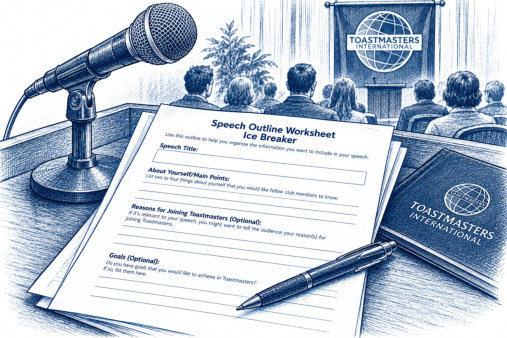
The Ice Breaker Worksheet A Tool for Every Speech One of the most valuable speechwriting resources in Pathways may be hiding in plain sight. It is called the Ice Breaker Speech Outline Worksheet. The name suggests it belongs to your first speech. But take another look—especially at pages 2 and 3. Those two pages provide a practical, reusable outline for almost any speech. They do not write the speech for you. They help you decide what belongs in it, where it belongs, and how to connect everything. Why It's Important A good topic does not automatically become a good speech. Ideas need an opening that attracts attention, a body that develops them, transitions that connect them, and a conclusion that leaves an impression. That is precisely the sequence shown on pages 2 and 3 of this Toastmasters worksheet. The prompts mention introducing yourself because it was designed for the Ice Breaker, but the underlying structure applies much more broadly. Page 1: Start Here, Then Adapt Page 1 asks for a Speech Title, two to four things About Yourself/Main Points, and optional Reasons for Joining Toastmasters and Goals. These are Ice Breaker-specific prompts. For another speech, replace them with your topic, two or three main ideas, and the message you want the audience to remember. Page 2: Build an Opening That Leads Somewhere The worksheet divides the Opening into four parts:
Then page 2 begins the Body with Main Point 1 and a separate Transition to the next point. This is a detail worth noticing: the worksheet does not treat transitions as an afterthought. Page 3: Connect Your Ideas and Finish Strong Page 3 continues with Main Point 2, another Transition, Main Point 3, and another transition before the conclusion. Its final two prompts are particularly useful:
Not every speech needs three main points. Use the worksheet as a guide, not a rigid formula. The value lies in consciously choosing your points, connecting them, and planning the ending. Helpful Tip Before writing your next speech, print pages 2 and 3. Fill in the spaces with a few words or short phrases. Pay special attention to the transitions and to the box labeled “Close with impact.” If you can outline your speech clearly, writing and rehearsing it will usually be easier. A Practical Example: A Speech About Mentoring Imagine using the actual worksheet headings for a speech on the value of mentoring:
Notice that this example uses the worksheet's actual progression. It is not simply a list of three ideas: it has an attention-getter, transitions, and a planned ending. A Resource for Every Member, Mentor, and VPE When someone says, “I know what I want to talk about, but I do not know how to organize it,” share this worksheet. A mentor can use it to ask questions without writing the member's speech. A VPE can recommend it to members preparing their next Pathways project. And experienced speakers can use it to test whether their message flows logically. Bottom Line The Ice Breaker may be a one-time project, but its Speech Outline Worksheet is not a one-time tool. Pages 2 and 3 offer something every speaker needs: a way to move from an interesting idea to a well-organized speech—with an opening, connected main points, and a conclusion that makes an impact. Keep this worksheet. Use it again. And pay special attention to those transitions! |
||||||||||||||||||||||
RESOURCES Ice Breaker Speech Outline Worksheet (PDF) | ||||||||||||||||||||||
|
Turn Every Pathways Pointer into a Speech — Speech Topic Library Toastmasters International Pathways
|
||||||||||||||||||||||