|
|||
|
|||
| PATHWAYS POINTERS OVERVIEW | |||
|
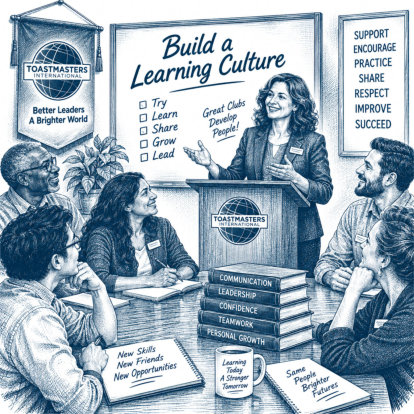
Build a Learning Culture Great Clubs Don't Just Hold Meetings—They Develop People A Toastmasters club can conduct excellent meetings week after week and still miss one of its most important purposes: helping members learn and grow. A strong learning culture doesn't happen automatically. It develops when officers and members create an environment where people are encouraged to try new things, ask questions, make mistakes, share knowledge, and stretch beyond what they already know. The question isn't simply, “Did we have a good meeting?” It is also, “Did someone learn something because of this meeting?” Why It’s Important
Members join Toastmasters to grow. When learning becomes part of the club's culture—not something that happens only during a prepared speech—members have more opportunities to build confidence, develop communication and leadership skills, and make meaningful progress in Pathways. A learning culture also makes it safer to be a beginner. Members are more willing to attempt unfamiliar roles, experiment with new techniques, ask for help, and accept constructive feedback when they know that learning—not perfection—is the expectation. A learning culture also makes it safer to be a beginner. Members are more willing to attempt unfamiliar roles, experiment with new techniques, ask for help, and accept constructive feedback when they know that learning—not perfection—is the expectation. Helpful Tip At your next officer meeting, ask one simple question: “What are we doing to help our members learn?” Don't limit the discussion to speeches. Consider evaluations, meeting roles, mentoring, Table Topics, educational presentations, Pathways projects, officer responsibilities, contests, special events, and informal conversations between members. Almost everything that happens in a Toastmasters club can become a learning opportunity. 1. Lead From the Top Club officers set the tone. Members notice what their leaders do, not simply what they tell others to do. DO: Let officers visibly participate in Pathways, give speeches, take meeting roles, attend training, ask questions, and talk about what they are learning. DON'T: Give members the impression that experienced Toastmasters have nothing left to learn. Leaders who continue learning give everyone else permission to do the same. 2. Recognize Learning—not Just Awards Toastmasters naturally recognizes accomplishments: completed projects, levels, Paths, contest achievements, and educational awards. But don't wait for the certificate before recognizing progress. DO: Recognize the member who attempts Table Topics for the first time, accepts a challenging meeting role, improves after an evaluation, mentors another member, or tries a new speaking technique. DON'T: Make formal achievements the only learning accomplishments worth celebrating. Sometimes the biggest step forward doesn't come with a badge. 3. Make Learning Part of Every Meeting Learning should not be reserved for prepared speeches. DO: Look for learning opportunities throughout the meeting—in evaluations, Table Topics, the Word of the Day, meeting roles, educational moments, and General Evaluator comments. DON'T: Treat learning as a special event that happens only during a workshop or Pathways project. A two-minute explanation of why someone did something effectively can sometimes teach the entire club. 4. Make It Safe to Learn People cannot learn if they are afraid to make mistakes. DO: Create an atmosphere where members can experiment, attempt unfamiliar roles, ask questions, and occasionally get something wrong. DON'T: Embarrass members, ridicule mistakes, or make beginners feel that they should already know everything. A first-time Toastmaster of the Day may forget something. A new evaluator may struggle. A speaker may try a technique that doesn't work. That's not failure. That's learning. 5. Involve Mentors and Experienced Members Your club already has a valuable educational resource: its members. DO: Encourage experienced members to mentor, coach, answer questions, demonstrate meeting roles, and help newer members navigate Pathways. DON'T: Assume the Vice President Education has to teach everyone everything. Learning becomes part of the culture when knowledge moves freely from one member to another. 6. Encourage Knowledge Sharing Every member knows something that could help someone else. DO: Invite members to share useful speaking techniques, leadership lessons, Pathways discoveries, meeting-role tips, technology shortcuts, and lessons learned from experience. DON'T: Let useful knowledge remain with only one person. If one member discovers an easier way to accomplish something, ask: “Who else could benefit from knowing this?” One person's discovery can become the entire club's knowledge. 7. Make Learning Accessible Members have different schedules, learning styles, experience levels, and needs. DO: Provide resources members can use when they need them—checklists, Pocket Guides, Pathways Pointers, sample scripts, worksheets, mentoring, recorded training when appropriate, and links to useful resources. DON'T: Assume that explaining something once at a club meeting means everyone now knows it. Sometimes members need information at the moment they are ready to use it. 8. Create Time to Learn A busy agenda can crowd out learning. DO: Occasionally make room for a short educational presentation, Pathways demonstration, role explanation, mentoring moment, or discussion of a leadership lesson. DON'T: Expect members to figure everything out on their own outside the meeting. Five focused minutes can sometimes remove a barrier that has been keeping a member from progressing for months. 9. Measure Growth—not Just Activity A full agenda doesn't necessarily mean members are developing. DO: Look beyond how many speeches were given or roles were filled. Ask whether members are progressing, trying new responsibilities, completing Pathways projects, improving their skills, and remaining engaged. DON'T: Confuse being busy with learning. The better question isn't “How much did we do?” It is “How did our members grow?” 10. Tell the Stories Learning becomes contagious when people see what it can accomplish. DO: Share success stories. Tell members about someone who conquered a fear, completed a difficult project, became comfortable with a new role, solved a leadership problem, or used a Toastmasters skill outside the club. DON'T: Let those stories disappear unnoticed. A certificate tells us that someone completed something. A story shows us why it mattered. Turn Club Experiences Into Pathways Opportunities A learning culture becomes especially powerful when members recognize that everyday Toastmasters experiences can support their Pathways journey. Leading an event can develop project-management and leadership skills. Mentoring a new member can strengthen coaching and interpersonal communication. Resolving a disagreement can teach conflict-management skills. Chairing a committee provides experience in delegation and teamwork. Trying a new speaking technique can become part of a Pathways project. Encourage members to ask: “What am I learning from this—and how can I use it in Pathways?” The club meeting and Pathways should not feel like two separate educational experiences. The club is where Pathways comes to life. A Simple Club Strategy Building a learning culture does not require adding another hour to your meetings or creating an elaborate new program. Start small and make learning visible.
The goal is not to create more work. The goal is to create more learning. Bottom Line A club with a learning culture doesn't need every meeting to be perfect. It needs members who are willing to try. It needs experienced members who are willing to teach. It needs officers who are willing to learn. It needs evaluations that help rather than discourage. It needs an environment where questions are welcomed, mistakes become lessons, accomplishments are recognized, and knowledge is shared. Most importantly, everyone needs to understand that Toastmasters isn't simply about conducting meetings or completing projects. It's about developing people. Great clubs don't just hold meetings. They develop people. |
|||
|
RESOURCES |
|||