|
|||
|
|||
| PATHWAYS POINTERS OVERVIEW | |||
|
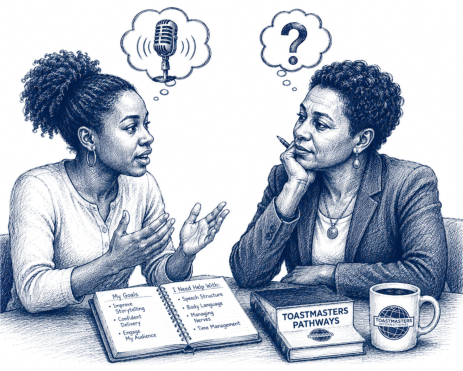
Your Mentor Cannot Read Your Mind A good mentor can encourage you, guide you, answer questions, suggest next steps, and help you stay connected to your Toastmasters goals. But even the best mentor cannot know what you need unless you speak up. Mentoring works best when it is a conversation, not a guessing game. New members sometimes wait for a mentor to tell them exactly what to do next. Experienced members may assume a mentor already knows they are confused, stuck, nervous, or unsure about Base Camp. In both cases, silence can slow progress. What’s New Enhanced Pathways gives members more ways to grow through speeches, meeting roles, leadership activities, and Education Series presentations. That variety is helpful, but it also means members may need more guidance choosing what to do next. A mentor can help — but only when the member shares questions, goals, concerns, and progress. Helpful Tip Bring one question to every mentor conversation. It does not have to be complicated. Ask about your next project, your next speech, your evaluation, your meeting role, or how to use feedback from your last assignment. One question can turn a short conversation into real progress. Mentoring Is a Partnership A mentor is not there to do the work for you. A mentor is there to help you understand the work, prepare for it, and learn from it. The member brings goals, questions, effort, and honesty. The mentor brings experience, encouragement, perspective, and practical advice. When both people participate, mentoring becomes useful. When only one person participates, mentoring becomes frustrating. What Your Mentor Needs to Know Your mentor does not need a long report. A few honest comments can help your mentor understand where you are and how to help.
Those simple statements give your mentor something useful to respond to. Questions Members Can Ask If you are not sure how to begin a mentor conversation, start with one of these questions:
A clear question gives your mentor a clear way to help. Mentors Should Ask, Too Mentoring is not only the member’s responsibility. Mentors can help by asking simple, direct questions instead of waiting for the member to request help.
These questions can uncover small problems before they become large obstacles. Silence Can Look Like Disinterest When a member does not ask questions, a mentor may assume everything is fine. When a mentor does not check in, a member may assume the mentor is not interested. Often, neither assumption is true. The member may be unsure what to ask. The mentor may be trying not to pressure the member. A brief conversation can clear up the misunderstanding. A Simple Club Strategy Clubs can make mentoring stronger by encouraging short, regular check-ins. These do not need to be formal meetings. A two-minute conversation before or after a club meeting can be enough.
The goal is not to create more work. The goal is to create more connection. Bottom Line Your mentor cannot read your mind. If you are confused, ask. If you are stuck, say so. If you have a goal, share it. If you need help choosing the next step, invite your mentor into the conversation. Mentoring works best when members and mentors talk openly, ask practical questions, and focus on the next clear step. In Pathways, progress grows faster when members do not try to figure everything out alone. |
|||
|
RESOURCES |
|||
|
Club Mentor Program: A Win-Win-Win! Introduction to Toastmasters Mentoring (Appears in Level 2 of every path). Mentoring (Manual 296 A) The Meaning of Good Mentoring Toastmasters International Pathways
|
|||