That’s normal — because you’re looking at the whole “degree plan” at once.
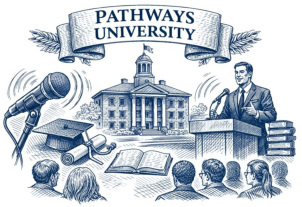
Think of Pathways like a university education. A college catalog looks impossible if you stare at the entire four-year program.
But students don’t do that. They take one semester and one course at a time.
Pathways works exactly the same way.
Choosing a major = Choosing a path
At university, once you pick a major, the curriculum is mapped out.
In Pathways, once you choose a path, your projects are already laid out in Base Camp.
No guessing. No designing your own program. Just follow the roadmap.
Year-by-year progress = Level-by-level progress
Students don’t worry about senior year on their first day of college.
Likewise, you don’t need to think about Level 5 while working on Level 1.
Focus forward — one level at a time.
Read the assignment before choosing the topic
In school, you don’t pick a topic before reading the assignment.
In Pathways, always read the project purpose first — then choose your speech topic.
This single habit prevents frustration.
The Registration Mindset
Treat Pathways like university registration:
• This level = your semester
• This project = your current course
• Your next requirement = your assignment
If you feel overwhelmed, ask one simple question: “What is my next required step?”
Then do only that.
Helpful Tip
Not sure which path (major) to choose?
Try the Pathways Assessment — quick, free, and surprisingly fun.
No obligation. Just guidance.
Bottom Line
Pathways isn’t complicated — it’s structured.
The overwhelm comes from trying to absorb the whole “degree plan” at once.
One level. One project. One step at a time.
That’s how people graduate — and how they succeed in Pathways.
Freshman basics = Level 1 fundamentals
Universities start with foundation courses.
Pathways starts with Level 1: Mastering the Fundamentals.
These projects build the core skills you’ll use in every later level.
Skipping the basics doesn’t make you faster — it makes later work harder.