
| << BACK | Page 1 of 5 | Pages: [2] [3] [4] [5] |
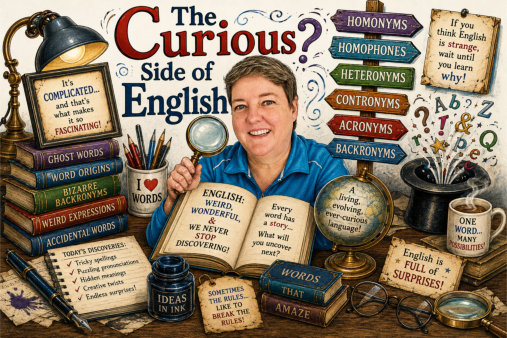
English is full of words that sound alike, look alike, or seem to mean the same thing—but don't! Understanding these differences can make us more confident speakers, writers, and communicators.
This month, we're looking at several terms that demonstrate just how interesting—and sometimes confusing—the English language can be: synonyms, antonyms, homonyms, homographs, heteronyms, contronyms, acronyms, and backronyms.
| FAIR | ||
| Synonym | Antonym | Homonym |
|---|---|---|
| equal | unequal | fair (carnival) |
Synonyms are words that have the same or nearly the same meaning. They add variety to our speaking and writing and help us avoid unnecessary repetition.
For example:
Big — large, huge, enormous
Smart — clever, intelligent, bright
Speak — talk, converse, communicate
But synonyms aren't necessarily identical. The word we choose can change the strength, mood, or even the picture we create.
Consider walk and saunter. Both describe moving on foot, but saunter suggests a slow, relaxed manner. Likewise, angry and furious are synonyms, but furious conveys considerably more intensity.
That's why synonyms are so useful to speakers. They don't just give us another word—they help us find the right word.
Antonyms are words with opposite or contrasting meanings.
For example:
Full ↔ empty
Fast ↔ slow
Happy ↔ sad
Success ↔ failure
Accept ↔ reject
Antonyms are particularly valuable to speakers because contrast gets attention.
The contrast between failure and success makes the message stronger and more memorable.
Sometimes we can even create an opposite by adding a prefix:
proper → improper
like → dislike
A small addition can completely reverse a word's meaning.
Homonyms are words that are spelled and pronounced the same but have different meanings.
For example:
Bat — an object used to hit a baseball
Bark — the sound a dog makes
Bark — the outer covering of a tree
Watch — a timepiece / to observe something
Trip — a journey / to stumble
Fire — a flame / to dismiss someone from a job
The spelling and pronunciation stay the same. The meaning depends entirely on the context.
Homographs are words that are spelled the same but have different meanings. They may be pronounced the same or differently.
For example, bat is also a homograph. The word is spelled the same whether it refers to a flying mammal or an object used in baseball.
Other examples include:
Does — female deer / performs or carries out
Row — a line of things / a noisy argument
Some homographs have the same spelling but change pronunciation as well as meaning. Those have a special name: heteronyms.
Heteronyms are a special type of homograph. They are spelled the same but are pronounced differently and have different meanings.
For example:
Lead (LED) — a metal
Tear (TEER) — a drop from the eye
Tear (TAIR) — to rip something
Wind (WIND) — moving air
Wind (WYND) — to twist or turn
Minute (MIN-it) — 60 seconds
Minute (my-NOOT) — extremely small
The spelling alone gives us no clue about which pronunciation or meaning is intended. We have to understand the context of the sentence.
Homograph: Same spelling + different meaning
Heteronym: Same spelling + different pronunciation + different meaning
Homophones are words that sound the same but have different spellings and meanings.
to / too / two
sea / see
right / write
Homophones remind us that hearing a word isn't always enough to know which word is intended.
Now English gets really strange.
A contronym is a word that can have two opposite or contradictory meanings, depending on how it is used.
Consider dust:
Dust the cake with powdered sugar — apply a fine powder
Or sanction:
The country imposed sanctions — imposed penalties or restrictions
And then there's oversight:
The mistake was an oversight — something that wasn't noticed
Contronyms remind us that context doesn't merely help us understand a word. Sometimes context can completely reverse its meaning.
We use acronyms so frequently that we sometimes forget they began as abbreviations.
An acronym is formed from the initial letters of a group of words and is pronounced as a word.
For example:
NATO — North Atlantic Treaty Organization
SCUBA — Self-Contained Underwater Breathing Apparatus
LASER — Light Amplification by Stimulated Emission of Radiation
There's an interesting distinction here. Abbreviations such as FBI, CEO, and DTM are technically initialisms, because we pronounce each letter separately rather than saying them as words.
but not all abbreviations are acronyms.
A backronym turns the normal acronym process around.
With an acronym, the phrase comes first and its initial letters create the shortened form.
With a backronym, the word or letters already exist, and someone later creates a phrase that fits them.
A familiar example is SOS. It is sometimes said to mean “Save Our Ship” or “Save Our Souls.” Those phrases were attached to SOS afterward. SOS was originally selected as a distress signal because its Morse code pattern was simple and distinctive.
Backronyms can also be humorous. For example, FORD has jokingly been expanded as “Fix Or Repair Daily.” The Ford name existed first; the phrase was invented later to fit the letters.
Backronyms are often created for humor, advertising, organizations, or as memory aids.
Backronym: Word or letters first → phrase created afterward
For Toastmasters, words are our tools, and English gives us quite a toolbox. The more precisely we understand words, the more effectively we can use them.
An antonym can create contrast.
A homonym can create confusion—or a great punchline.
A homograph reminds us that identical spelling doesn't always mean identical meaning.
A heteronym can challenge our pronunciation.
A contronym can completely change meaning through context.
An acronym can make a long name memorable.
And a backronym shows just how creative we can be with language.
It's understanding exactly what that word is doing.
And sometimes, that makes all the difference.
YourDictionary — Synonyms, Antonyms and Homonyms
Karen Storey, DTM: karen@karenstorey.com
Frank Storey, DTM: fstorey1943@gmail.com